
Plastic waste: Commission consults on new rules for chemically-recycled content in plastic bottles
July 2025: The initiative will provide a common methodology for calculating, verifying and reporting on recycled plastic content in single-use beverage bottles.
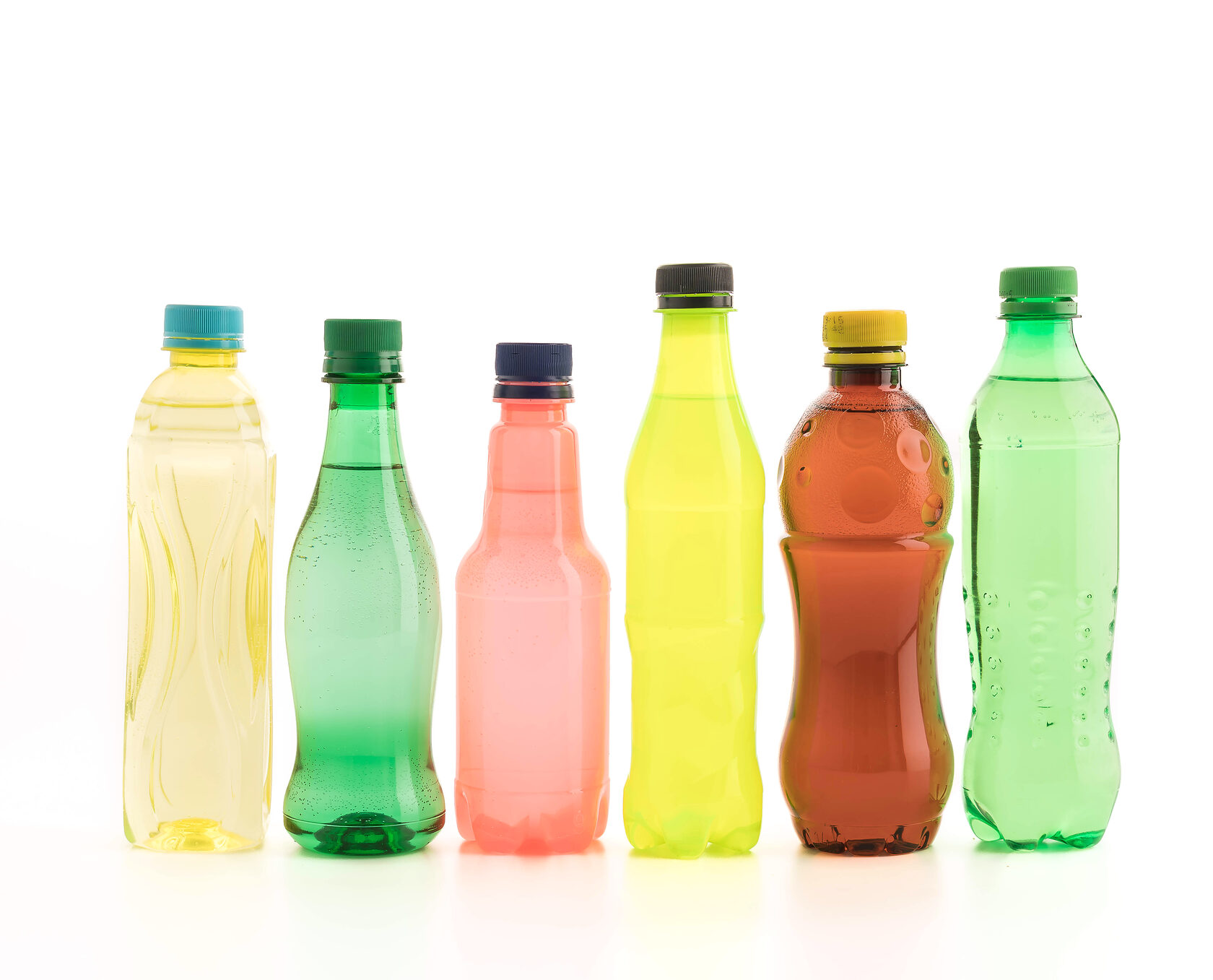
The European Commission has launched a public consultation on rules for calculating, verifying and reporting recycled content in single-use plastic (SUP) beverage bottles, including chemically-recycled content.
The adoption of the rules will enable chemical recycling in the EU and will help economic actors meet the ambitious recycled content targets set under the Single-Use Plastics Directive (SUPD).
By incentivising investments and supporting new recycling technologies, the rules will boost the competitiveness of both the EU chemical industry and manufacturers that use plastics in their production, helping to establish Europe as a leader in sustainable innovation. The measures will also benefit the environment, as they will economically incentivise producers to reuse plastic waste, rather than disposing of it in landfills, littering or incinerating it.
The rules are part of the new Action Plan for the EU Chemicals Industry, designed to strengthen the sector’s competitiveness and drive its transition toward safe, sustainable, and innovative chemical production.
Read more here.
The adoption of the rules will enable chemical recycling in the EU and will help economic actors meet the ambitious recycled content targets set under the Single-Use Plastics Directive (SUPD).
By incentivising investments and supporting new recycling technologies, the rules will boost the competitiveness of both the EU chemical industry and manufacturers that use plastics in their production, helping to establish Europe as a leader in sustainable innovation. The measures will also benefit the environment, as they will economically incentivise producers to reuse plastic waste, rather than disposing of it in landfills, littering or incinerating it.
The rules are part of the new Action Plan for the EU Chemicals Industry, designed to strengthen the sector’s competitiveness and drive its transition toward safe, sustainable, and innovative chemical production.
Read more here.
New rules to boost recycling efficiency and material recovery from waste batteries
The measures will boost the recovery and recycling of critical and strategic raw materials.
The Commission published new rules on Friday for calculating and verifying recycling efficiency and the recovery of materials from waste batteries.
Batteries play a crucial role in advancing the green transition, supporting sustainable mobility, and contributing to climate neutrality by 2050. The new rules aim to support a circular, resilient and competitive economy by keeping the materials used in batteries in the economy for longer, thus preventing waste.
The objective of these rules is to ensure the high-quality recycling and recovery of materials from waste batteries, particularly those containing critical and strategic raw materials.
They establish clear and consistent calculation guidelines for recyclers, aiming to prevent unfair competition in the EU’s market for secondary raw materials from waste batteries.
The methodology for measuring the recycling efficiency of recyclers, which quantifies the total amount of materials recycled, is established for batteries containing lead-acid, nickel-cadmium, lithium and other materials.
The process for measuring the recovery of materials is specifically established for critical raw materials such as cobalt, copper, lithium and nickel, as well as lead.
The newly established methodology entered into force on 24 July 2025.
Annex XII of the Batteries Regulation mandates ambitious targets for the recycling efficiency to be achieved by recyclers no later than 31 December 2025 (75% for lead-acid batteries, 65% for lithium-based batteries, 80% for nickel-cadmium batteries, 50% for other batteries).
The targets will be increased by 31 December 2030 for lead-acid batteries (80%) and lithium-based batteries (70%).
The material recovery targets to be achieved by 31 December 2027 are 90% for cobalt, copper, lead, and nickel and 50% for lithium.
These will be increased by 31 December 2031 to 95% for cobalt, copper, lead, and nickel and 80% for lithium.
Batteries play a crucial role in advancing the green transition, supporting sustainable mobility, and contributing to climate neutrality by 2050. The new rules aim to support a circular, resilient and competitive economy by keeping the materials used in batteries in the economy for longer, thus preventing waste.
The objective of these rules is to ensure the high-quality recycling and recovery of materials from waste batteries, particularly those containing critical and strategic raw materials.
They establish clear and consistent calculation guidelines for recyclers, aiming to prevent unfair competition in the EU’s market for secondary raw materials from waste batteries.
The methodology for measuring the recycling efficiency of recyclers, which quantifies the total amount of materials recycled, is established for batteries containing lead-acid, nickel-cadmium, lithium and other materials.
The process for measuring the recovery of materials is specifically established for critical raw materials such as cobalt, copper, lithium and nickel, as well as lead.
The newly established methodology entered into force on 24 July 2025.
Annex XII of the Batteries Regulation mandates ambitious targets for the recycling efficiency to be achieved by recyclers no later than 31 December 2025 (75% for lead-acid batteries, 65% for lithium-based batteries, 80% for nickel-cadmium batteries, 50% for other batteries).
The targets will be increased by 31 December 2030 for lead-acid batteries (80%) and lithium-based batteries (70%).
The material recovery targets to be achieved by 31 December 2027 are 90% for cobalt, copper, lead, and nickel and 50% for lithium.
These will be increased by 31 December 2031 to 95% for cobalt, copper, lead, and nickel and 80% for lithium.
EU Targets Doubling Circularity Rate with New Circular Economy Act by 2030
- The Circular Economy Act aims to double the EU’s circularity rate and establish a single market for secondary raw materials by 2030.
- Two main policy pillars: improving e-waste recycling and scaling demand for secondary critical raw materials.
- Consultation and Call for Evidence are open until November 6, 2025, with the Act expected to be adopted in 2026.
Set for adoption in 2026, the Act is designed to enhance the EU’s economic security, resilience, competitiveness, and decarbonization efforts. It will also support the goals of the Competitiveness Compass and the Clean Industrial Deal to position the EU as a global leader in circular economy practices by 2030.
This initiative will also be aligned with key EU strategies and regulations, including the Single Market Strategy, the Steel and Metals Action Plan, the Ecodesign for Sustainable Products Regulation, the Packaging and Packaging Waste Regulation, and the Critical Raw Materials Act.
This initiative will also be aligned with key EU strategies and regulations, including the Single Market Strategy, the Steel and Metals Action Plan, the Ecodesign for Sustainable Products Regulation, the Packaging and Packaging Waste Regulation, and the Critical Raw Materials Act.
EU Approves New Rules to Cut Food and Textile Waste
September 2025: The European Parliament gave its final approval on new rules for EU countries to reduce the mountains of food wasted in Europe each year and to curb the environmental impact of fast fashion.

By 2030, member states will have to slash the food waste generated by households, retailers and restaurants, by 30 percent, compared to 2021-2023 levels.
They will also have to cut 10 percent of the waste generated by food processing and manufacturing.
The EU estimates that the bloc generates around 130 kilogrammes of food waste per person each year, adding up to 60 million tonnes.
Regarding textiles, EU countries will be required to establish producer responsibility schemes, through which manufacturers who make textile products available in an EU country will have to cover the costs of their collection, sorting, and recycling, starting 30 months after the directive enters into force.
Less than one percent of textiles worldwide are recycled at present, according to the EU, with 12.6 million tonnes of textile waste generated in the bloc each year.
There are a variety of approaches so far from member states (countries) to tackle this waste. Read here.
They will also have to cut 10 percent of the waste generated by food processing and manufacturing.
The EU estimates that the bloc generates around 130 kilogrammes of food waste per person each year, adding up to 60 million tonnes.
Regarding textiles, EU countries will be required to establish producer responsibility schemes, through which manufacturers who make textile products available in an EU country will have to cover the costs of their collection, sorting, and recycling, starting 30 months after the directive enters into force.
Less than one percent of textiles worldwide are recycled at present, according to the EU, with 12.6 million tonnes of textile waste generated in the bloc each year.
There are a variety of approaches so far from member states (countries) to tackle this waste. Read here.
EPR News: textile and food waste
The targeted revision of the Waste Framework Directive entered into force 16 October, introducing common rules for extended producer responsibility (EPR) for textiles and setting binding food waste reduction targets for Member States.
It will help reduce waste, mitigate environmental damage, and enhance the EU’s economic security and resilience by driving innovation in sustainable practices and reducing dependency on raw materials, in line with the EU’s Competitiveness Compass and Strategic Agenda for 2024-29.
The revised Waste Framework Directive introduces two main sets of measures to tackle these impacts, while boosting the competitiveness and circularity of the sector:
Mandatory EPR schemes for textile and footwear products: All Member States are required to establish their own EPR scheme for textiles and footwear, following common rules applicable across the EU.
New rules for the management of used textiles and textile waste.
All details are here.
The revised Waste Framework Directive introduces two main sets of measures to tackle these impacts, while boosting the competitiveness and circularity of the sector:
Mandatory EPR schemes for textile and footwear products: All Member States are required to establish their own EPR scheme for textiles and footwear, following common rules applicable across the EU.
New rules for the management of used textiles and textile waste.
All details are here.
Plastic packaging waste in the EU: 35.3 kg per person
October 2025:
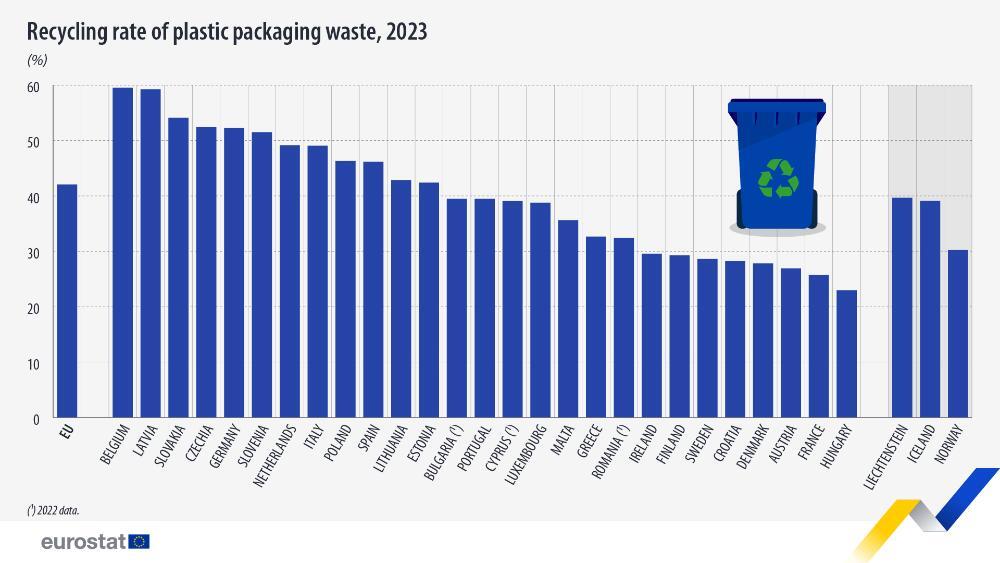
Data from Eurostat: in 2023, the EU generated ~35.3 kg of plastic packaging waste per person, of which ~14.8 kg was recycled; recycling rate ~42.1%.
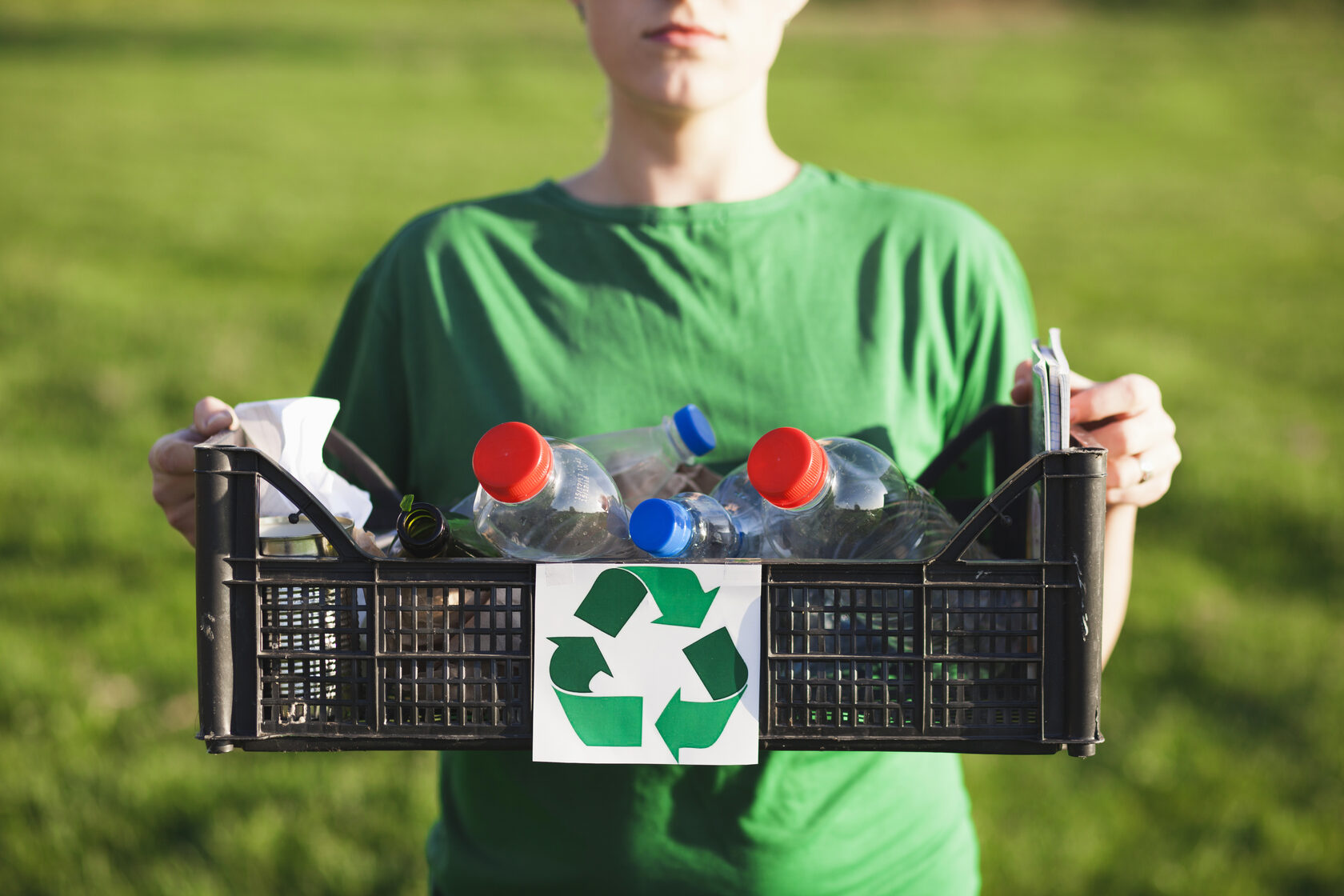
In 2023, 79.7 million tonnes of packaging waste were generated in the EU, or 177.8 kg per inhabitant. While this marks a reduction of 8.7 kg per capita compared with 2022, the figure remains 21.2 kg higher than in 2013.
Out of all the packaging waste generated, 40.4% was paper and cardboard, 19.8% was plastic, 18.8% glass, 15.8% wood, 4.9% metal and 0.2% other packaging.
An average of 35.3 kg of plastic packaging waste was generated in 2023 for each person living in the EU. Out of this, 14.8 kg were recycled.
Out of all the packaging waste generated, 40.4% was paper and cardboard, 19.8% was plastic, 18.8% glass, 15.8% wood, 4.9% metal and 0.2% other packaging.
An average of 35.3 kg of plastic packaging waste was generated in 2023 for each person living in the EU. Out of this, 14.8 kg were recycled.
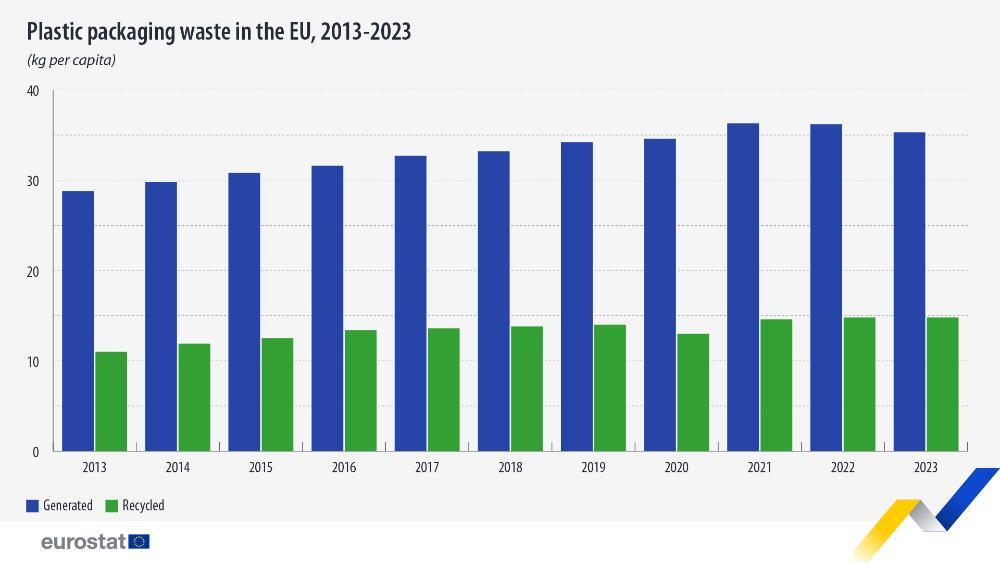
In 2023, the EU recycled 42.1% of all the generated plastic packaging waste, indicating an increase in the recycling rate compared with 2013 (38.2%).
Belgium recorded the highest recycling rate at 59.5%, followed by Latvia (59.2%) and Slovakia (54.1%).
In contrast, the lowest rates were recorded in Hungary (23.0%), France (25.7%) and Austria (26.9%).
Belgium recorded the highest recycling rate at 59.5%, followed by Latvia (59.2%) and Slovakia (54.1%).
In contrast, the lowest rates were recorded in Hungary (23.0%), France (25.7%) and Austria (26.9%).
EU economy greenhouse gas emissions: -0.4% in Q2 2025
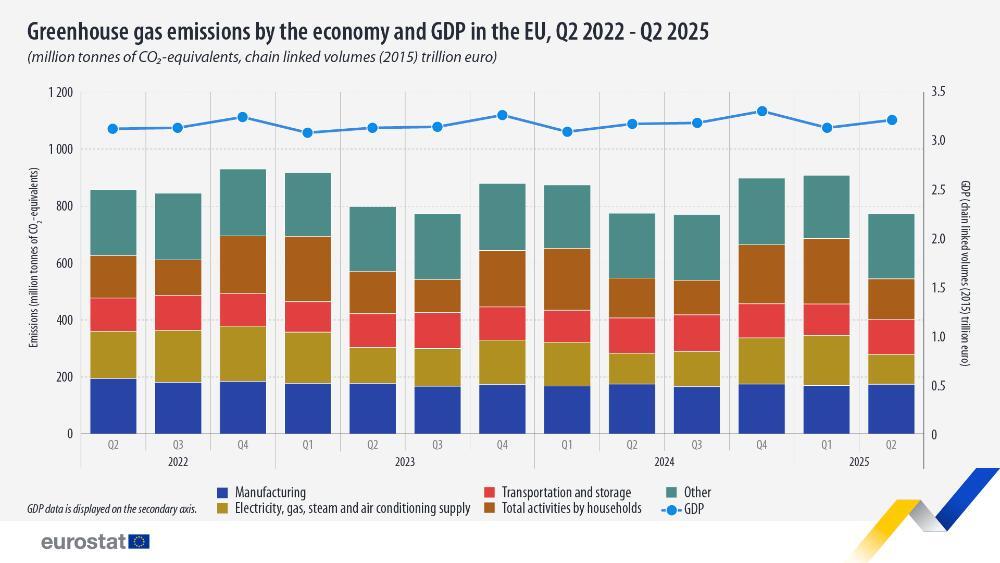
November 2025: The EU economy’s greenhouse gas emissions in the second quarter of 2025 were estimated at 772 million tonnes of CO2-equivalents (CO2-eq, a 0.4% decrease compared with the same quarter of 2024 (775 million tonnes of CO2-eq). At the same time, the EU’s gross domestic product (GDP) increased by 1.3% in the second quarter of 2025, compared with the same quarter of 2024.
The economic sectors responsible for the largest year-on-year decreases were electricity, gas, steam and air conditioning supply (-2.9%), manufacturing (-0.4%) and transportation and storage (-0.4%). In contrast, households increased their emissions by 1.0%.
Greenhouse gas emissions decreased in 12 EU countries.
The largest reductions in greenhouse gases were estimated for Slovenia (-8.6%), the Netherlands (-5.9%) and Finland (-4.2%).
Out of the 12 EU countries that registered decreases in greenhouse gas emissions, 3 also recorded a decline in their GDP (Finland, Germany and Luxembourg). The other 9 EU countries (Austria, Cyprus, Denmark, France, Italy, the Netherlands, Romania, Slovenia and Sweden) were estimated to have decreased emissions while growing their GDP.
The largest reductions in greenhouse gases were estimated for Slovenia (-8.6%), the Netherlands (-5.9%) and Finland (-4.2%).
Out of the 12 EU countries that registered decreases in greenhouse gas emissions, 3 also recorded a decline in their GDP (Finland, Germany and Luxembourg). The other 9 EU countries (Austria, Cyprus, Denmark, France, Italy, the Netherlands, Romania, Slovenia and Sweden) were estimated to have decreased emissions while growing their GDP.

